
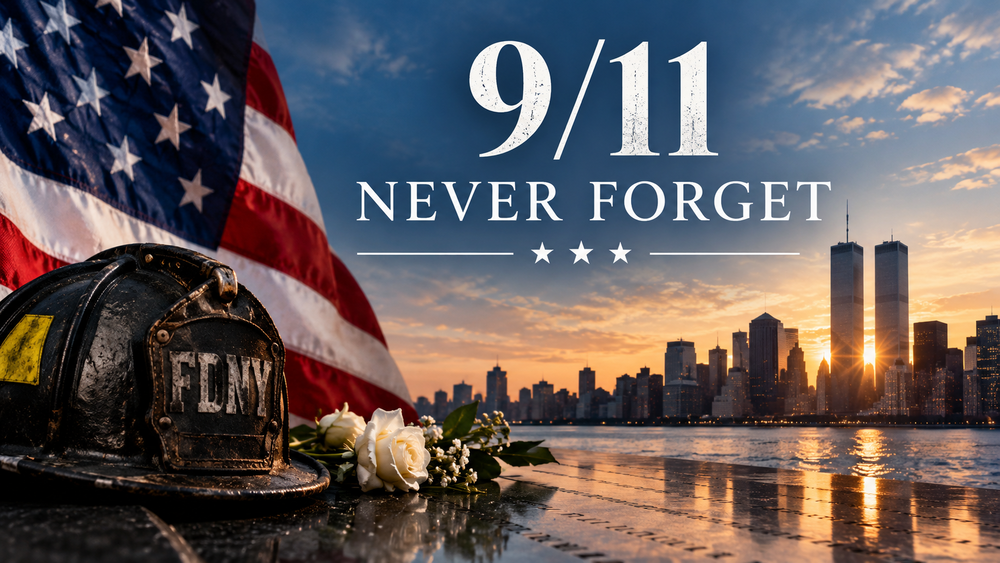
🇺🇸 25 Years Later: Remembering September 11, 2001 🇺🇸
English I students connect history, family memories, and storytelling
Today in Mrs. Myra Barne's English I class, we stepped away from the ordinary to spend time learning about and remembering the events of September 11, 2001. This year marks 25 years since 9/11, and none of the students sitting in our classroom today were alive when it happened. That makes teaching this history and continuing to tell its stories, even more important.
Introducing students to the events of September 11 and the story of “Little Red.”
We began by learning about the events and timeline of that morning and how September 11 forever changed our country. Students then did something simple but incredibly meaningful: they texted a parent, grandparent, relative, or other adult and asked, “Where were you when you heard about the attacks on September 11?”
The responses immediately connected history to real people. For our students, September 11 is a historical event they have only heard about. For the adults in their lives, it is often a vivid memory when they can still recall exactly where they were and what they were doing.
Students shared and discussed the memories their families sent back to them.
A Grandfather’s Memory
One student’s grandfather shared this memory with our class:
“I was in a meeting when the first plane hit. We turned on the television and were watching the news when the second plane hit. I remember going back to my crew and letting them know what was going on. I watched the news for the rest of the day to see what was happening.
I remember the plane crashing in the middle of nowhere, and I remember the plane crashing into the Pentagon. I work at Caterpillar in Corinth now, and we have the actual CAT generator that was below the spot in the Pentagon where the plane crashed. It rests on a pentagon-shaped slab of concrete in front of our Cardinal Drive plant, which is where I work.”
The Caterpillar display at the Cardinal Drive plant in Corinth connects our local community to the history of September 11.
That story made the lesson especially personal. A date in a history book became a grandfather remembering exactly where he was, what he saw on television, and how he shared the news with his crew. Even more remarkably, an artifact connected to the Pentagon now has a connection to our own community.
Giving “Little Red” a Voice
Students were then introduced to “Little Red,” a Chances for Children Charity mascot that was discovered among the rubble on the morning of September 12 by EMT Brian Van Flandern and is now preserved in the collection of the National September 11 Memorial & Museum.
Then our students became storytellers.
Students planned and wrote their historical-fiction narratives from Little Red’s point of view.
Taking on the persona of Little Red, students wrote an original historical-fiction narrative from her point of view, imagining what she might have seen, heard, felt, and experienced on September 11 before eventually being discovered in the rubble.
As they wrote, they incorporated the literary skills we have been studying in English I, including imagery, simile, metaphor, personification, symbolism, characterization, conflict, mood, tone, foreshadowing, theme, point of view, and other literary devices.
Students worked together to develop ideas to create their handwritten stories.
The assignment practiced English I standards, but its purpose went far beyond literary devices. Through family memories and the imagined perspective of one small artifact, students considered the fear, courage, sacrifice, service, hope, unity, and resilience connected to September 11.
Why It Matters 25 Years Later
There is something especially meaningful about teaching this lesson 25 years later. Our students cannot remember September 11 for themselves. They depend on those who experienced it to tell them where they were, what they saw, what they felt, and how the country changed afterward.
As more time passes, those firsthand stories become increasingly important. Connecting students with the memories of their own families and then asking them to use writing to step into the perspective of an artifact from that day, helped turn history into something more personal, thoughtful, and memorable.
If we want the next generation to understand why September 11 matters, we have to continue teaching it, talking about it, and telling its stories.
We remember the lives lost. We remember the heroes and first responders. We remember the families. We remember the courage of ordinary people. We remember how our nation was changed. And 25 years later, we will continue telling their stories.
🇺🇸 We will never forget. 🇺🇸
#NeverForget #September11 #911Remembrance #25YearsLater #HistoricalFiction #LearningThroughLiterature